
Peer-reviewed Publication

Civic ecosystem responses to compound crises: evidence from Syria
Munzer Alkhalil Affiliations & notes a LSE IDEAS, The London School of Economics and Political Science, and David Nott Foundation, United Kingdom Zedoun Alzoubi Affiliations & notes b LSE IDEAS, The London School of Economics and Political Science, United Kingdom, and Research for Health System Strengthening in Syria, Union of Medical Care and Relief Organizations, Syria Mazen Gharibah Affiliations & notes c LSE IDEAS, The London School of Economics and Political Science, United Kingdom Zaki Mehchy Affiliations & notes c LSE IDEAS, The London School of Economics and Political Science, United Kingdom Iavor Rangelov Affiliations & notes c LSE IDEAS, The London School of Economics and Political Science, United Kingdom Marika Theros Affiliations & notes c LSE IDEAS, The London School of Economics and Political Science, United Kingdom Rim Turkmani Affiliations & notes c LSE IDEAS, The London School of Economics and Political Science, United Kingdom
Affiliations & notes
  • a LSE IDEAS, The London School of Economics and Political Science, and David Nott Foundation, United Kingdom
  • b LSE IDEAS, The London School of Economics and Political Science, United Kingdom, and Research for Health System Strengthening in Syria, Union of Medical Care and Relief Organizations, Syria
  • c LSE IDEAS, The London School of Economics and Political Science, United Kingdom
Publication date: 21 September 2026 Research Paper DOI: https://doi.org/10.1111/disa.70070
Corresponding author
Marika Theros

Abstract

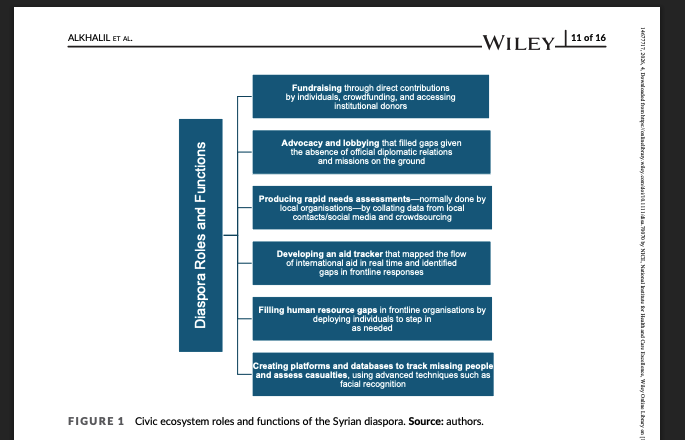
Compound crises have attracted growing interest from scholars and policymakers in recent years. Little attention, however, has been directed to the social relations that emerge from and respond to such phenomena. This paper closes the gap by investigating the emergence, impact, and limitations of the civic ecosystem that responded to the earthquakes in northwest Syria in 2023, an area already affected by protracted armed conflict, mass displacement, and humanitarian emergency. We combine ideas from complex adaptive systems theory, civic ecosystems scholarship, and the literature on compound crises to analyse primary data and evidence collected through key informant interviews, a focus group discussion, and participatory observation. The paper contends that compound crises present distinctive challenges and opportunities that civic ecosystems are particularly adept at addressing and exploiting. We show how they evolve through adaptive cycles of learning and innovation across multiple co-occurring shocks. One implication of the argument is the need to apply systems theory to understand how systems can tackle, rather than only produce, complex social problems such as compound crises.

View original source

Discussion

No comments have been published yet.